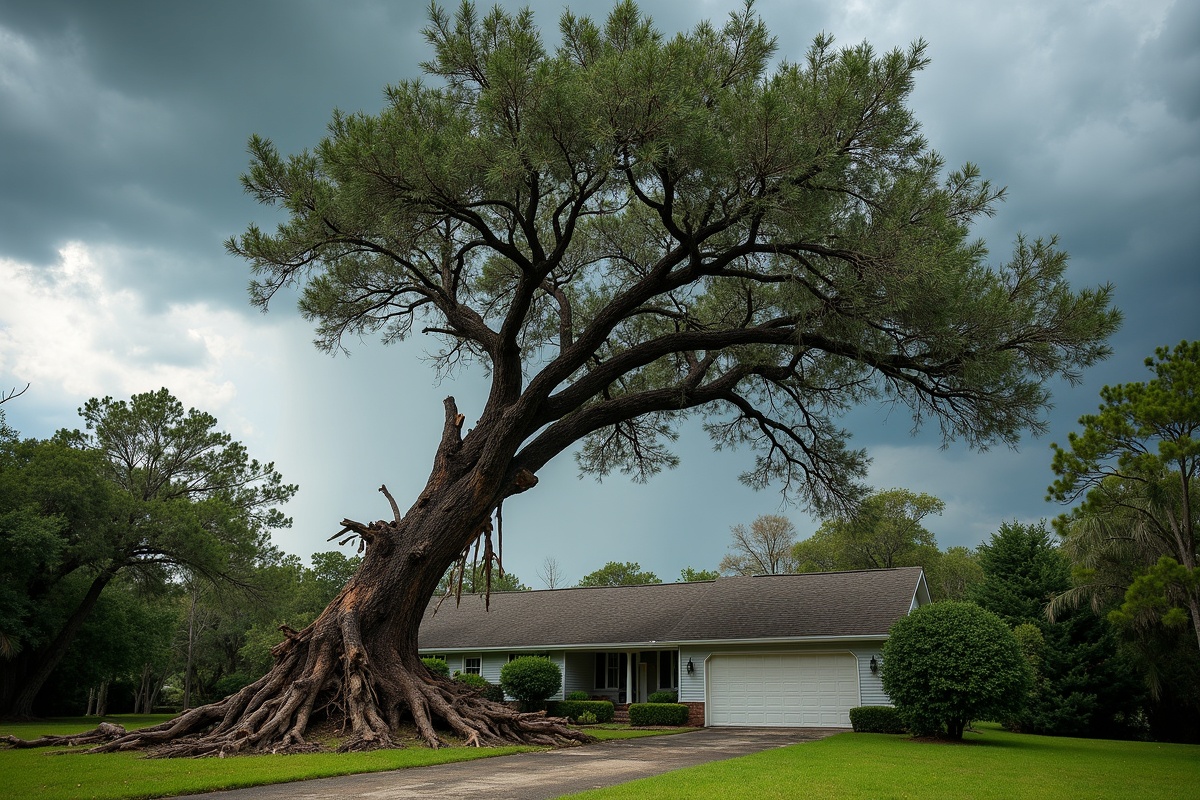
Most trees are assets. The live oaks arching over downtown Wilmington’s historic streets, the longleaf pines standing along the coastal plain, the loblolly pines rising across residential lots throughout New Hanover County — properly maintained, these trees deliver real value: shade that cuts cooling costs through Carolina’s long summers, wildlife habitat, property character, and sometimes decades of irreplaceable canopy.
But a tree in poor structural condition — dead, diseased, structurally compromised, or root-damaged — is a different story, especially on the coast. In Wilmington, where hurricane season runs six months of the year, nor’easters roll in through winter, and severe thunderstorms are a summer regular, a hazardous tree isn’t just an eyesore. It’s a liability.
The challenge is that many of the most dangerous trees don’t look particularly alarming from the street. You don’t need to be an ISA Certified Arborist to spot warning signs, but you do need to know what to look for. This guide focuses on the specific signs Wilmington homeowners should know for the two most common significant-tree types here: southern live oaks and the native pines (loblolly, longleaf, and pond pine).
Why Hazard Trees Are a Particular Concern in Wilmington
Cape Fear coastal conditions create specific factors that make hazard assessment genuinely important here:
Named storm history. Wilmington has been hit hard. Hurricane Fran (1996) and Hurricane Florence (2018) together caused billions in property damage in New Hanover County, with trees among the primary damage mechanisms — Florence alone led to over 1.2 million cubic yards of tree and structural debris collected countywide. Post-storm damage surveys consistently show the trees that failed were disproportionately the ones with pre-existing structural issues, disease, or neglected maintenance.
Saturated soil and flooding. Florence was the wettest tropical cyclone in North Carolina history, dropping more than 23 inches of rain on Wilmington and cutting the city off as roads flooded. On the Cape Fear coast, the danger isn’t only wind — days of rain can saturate low-lying ground until otherwise-stable trees uproot at wind speeds they’d normally shrug off.
Sandy and low-lying soils. Wilmington’s sandy coastal soils drain well but give root systems less anchoring resistance than firm clay. Add flood-prone bottomlands near the river and marsh, and trees with compromised roots can go over at lower wind speeds than similar trees inland.
Salt exposure. Proximity to the Atlantic and the Cape Fear River means many properties see salt-laden air that stresses trees over time, making them more susceptible to disease and pest damage — especially when combined with storm stress from previous events.
Pine beetle and disease pressure. The region’s pines face ongoing pressure from southern pine beetle and Ips beetles, particularly in drought-stressed or overcrowded stands. A pine can go from stressed to dead within a single season, and a dead pine near a structure is one of the most urgent hazards you can have.
Warning Signs Specific to Southern Live Oaks
Live oaks (Quercus virginiana) are Wilmington’s most iconic trees and, when healthy and well-maintained, extremely resilient. But mature live oaks can develop serious structural problems, and because they’re large and often close to homes, those problems carry significant risk.
Large Dead Branches in the Crown
Dead branches in a live oak crown — sometimes called “widow makers” — are the single most common hazard sign in coastal trees. A dead limb in a live oak doesn’t fall on a schedule. It can come down on a still day, during a storm, or when wind vibration shakes the canopy.
What to look for:
- Branches with no leaves during the growing season (spring through fall) while surrounding branches are fully leafed
- Branches with dry, cracked bark and visible gray or bleached wood
- Brittle-looking branch tips that contrast with the flexible, green twigs on healthy parts of the tree
- Mushrooms or other fungal growth on large limbs (indicates decay in that limb)
A single small dead branch on a live oak is normal — trees shed small branches naturally. What’s concerning is multiple large dead branches, or a significant section of the crown where the wood has died back.
Included Bark in Co-Dominant Stems
This is one of the most important structural defects in mature live oaks and one of the least visible from the ground. Many live oaks develop two or more main stems (co-dominant stems) splitting from a common base. When these stems press together at a tight angle, bark becomes embedded in the union — “included bark.”
A normal, healthy union has a collar — a ridge of wood wrapping around the base of the stem that provides structural support. An included-bark union lacks this collar. The stems are essentially just pressing against each other with bark between them — a weak connection that can fail, often catastrophically, under storm load.
How to spot it: Look at the crotch where two major stems diverge. A healthy union shows a visible ridge or collar of wood. An included-bark union shows a tight, compressive groove with embedded bark — sometimes with a vertical crease in the crotch. The tighter the angle between stems, the worse the included bark tends to be.
Included bark in small stems is manageable through early structural pruning. In large, mature co-dominant live oak stems, it’s a serious defect. Trees with large-diameter co-dominant stems showing obvious included bark should be evaluated by a professional before storm season.
Horizontal Limbs With Excessive Span or End-Weight
Live oaks are celebrated for their sweeping horizontal limbs — it’s part of what makes them magnificent. But very long horizontal limbs with heavy ends can develop cracks and splitting stress over time, and they catch significant lift force in high wind.
Warning signs in horizontal limbs:
- Visible cracks at the base of the limb where it joins the main trunk
- Slight downward sag that has increased over time
- Previous storm damage (split, cracked, or taped/braced limbs from prior events)
- Limbs passing over your roofline, driveway, or living areas
Fungal Growth at the Base of the Trunk
Bracket fungi (conks) at the base of a live oak trunk — particularly large, shelf-like mushrooms attached to bark or roots — are a serious warning sign. They indicate wood decay in the root system or trunk base. A tree with significant basal rot has less structural integrity than it appears from outside.
What to look for:
- Any shelf-like, bracket, or mushroom growth on the trunk below about 5 feet
- Clusters of smaller mushrooms emerging from roots or at the soil line
- Soft or discolored bark at the base of the trunk
Not all fungi on trees are dangerous — some grow on dead bark or surface organics. But basal fungi tied to the root system or trunk wood warrant a professional evaluation.
Sudden or Progressive Lean
A lean that has appeared or increased — especially after a rainstorm or flooding event — points to root problems. A tree that was upright and is now noticeably leaning has experienced some root-plate movement.
Urgency signals:
- Soil cracking or lifting on the side opposite the lean
- Visible exposed roots on one side
- The lean appeared suddenly rather than developing over years
A suddenly leaning live oak near a structure is an urgent situation, not a “we’ll schedule it next month” situation — particularly after the saturated-soil conditions that Cape Fear storms bring.
Warning Signs Specific to Pines
Wilmington-area pines — mainly loblolly, longleaf, and pond pine — fail in storms differently than live oaks. Where live oaks lose limbs or partially uproot, pines more commonly snap — trunk failure at mid-height, often with little warning. Knowing the specific pine signs matters because by the time a pine looks severely distressed, removal may be urgently needed.
Yellowing or Browning Needles
Healthy pines have deep green needles. When needles begin yellowing or browning — particularly in the upper crown or on one side — it signals serious stress. Common causes:
- Bark beetle infestation (see below) — needles fade from green to yellow to red-brown as the tree dies
- Root damage from construction, soil compaction, or flooding
- Laurel wilt (primarily affects redbay and swamp bay but reflects the region’s pest pressure)
- Drought stress combined with root damage
A pine losing significant needle color is in serious decline, and declining pines near structures should be evaluated promptly.
Signs of Bark Beetle Infestation
Southern pine beetle and Ips beetles are the most significant tree-health threat to coastal Carolina’s pine population. Bark beetles attack stressed trees, laying eggs under the bark; the larvae kill the cambium as they feed, effectively girdling the tree. A heavily infested pine can be dead within a season.
Evidence of bark beetle activity:
- Small circular entry and exit holes in the bark (roughly 1/8 to 1/4 inch depending on species)
- Reddish-brown “frass” (sawdust mixed with excrement) accumulating at the base or in bark crevices
- Pitch tubes — small globs of dried resin on the bark surface, where the tree tried to “pitch out” a beetle attack
- Blue-stain in the wood visible in a branch or trunk cross-section (from the fungus the beetles carry)
Once a pine is heavily infested and the needles are fading, it’s typically beyond treatment. Removal before the tree becomes a structural hazard — and before the beetle population spreads to neighboring pines — is the recommended course.
A Dead Pine Near Your Home
A dead pine is a straightforward hazard: the trunk gets more brittle by the month, the root system loses its living anchor, and the whole tree can snap or topple with less wind than a healthy tree would need. Dead pines need to come down — the only question is whether that happens on your schedule or during the next storm.
If you have a dead or dying pine within falling distance of your home, fence, vehicle, or a neighboring structure, this is a priority item before storm season.
Sparse or Lost Canopy
Pines that have progressively lost canopy density over several seasons — fewer, shorter needles, bare sections of crown — are chronically stressed. Chronic stress makes pines susceptible to beetle infestation, weakens root vitality, and undermines wood structure. A pine that was full five years ago but is now noticeably thinner and patchier warrants a professional look.
Tight Stand Spacing
Pines that grew up in tight clusters — common in New Hanover County’s transitional forest areas and in some older subdivision plantings — often develop shallow root systems because they compete for lateral space. Shallow roots mean less storm anchorage. When the stand thins (naturally or by removal of some trees), the remaining pines may suddenly be more wind-exposed than their roots can handle.
Warning Signs That Apply to Both Live Oaks and Pines
Trunk Cavities and Soft Spots
Any hollow space or visibly rotted area in a trunk is a concern. Tapping the trunk with a mallet or tool handle and listening for a hollow sound (versus a solid thud) can indicate internal decay — though it’s imprecise. Soft spots where the wood under the bark yields to pressure indicate decay.
A tree doesn’t have to be fully hollow to be at serious risk. Significant decay in even part of the trunk’s cross-section reduces load-bearing capacity in ways that may not be visible until failure.
Cracks in the Trunk
Deep vertical cracks (as opposed to normal surface bark fissuring) can indicate internal stress fractures. Horizontal cracks are particularly serious. Cracks at old wound sites that haven’t closed are ongoing entry points for decay.
Root Zone Disturbance
Construction, utility trenching, soil grading, or new impervious surface (driveway extensions, patios, additions) within the root zone — generally out to the drip line or beyond — can cause root damage that doesn’t show in the canopy for 1 to 3 years. If your property has had significant construction near a large tree in the past few years, and that tree is now showing any canopy decline, root damage is a likely cause. In the Wilmington area, repeated flooding and soil saturation can compound this.
The Difference Between “Needs Pruning” and “Needs Removal”
Not every warning sign means the tree must come out. Many trees with identifiable issues can be made significantly safer through proper pruning — removing deadwood, thinning the crown, or addressing smaller co-dominant stems early.
A tree generally needs removal when:
- It is dead or has no viable path to recovery
- Structural failure is likely regardless of pruning (major root rot, large hollow trunk section)
- The failure zone includes structures or areas where people spend time, and pruning cannot adequately reduce risk
- The tree suffered catastrophic storm damage that left it permanently compromised
A tree may be maintained through pruning when:
- The structural issues are in the canopy (deadwood, crossing branches, smaller co-dominant stems still manageable)
- The trunk and root system are sound
- The tree is otherwise healthy and removal would be a significant, irreplaceable loss
The distinction requires an on-site assessment by someone who can actually look at the tree — photos and descriptions only go so far.
When to Call a Professional
If you’re not sure, call a professional. Situations that warrant an urgent call rather than scheduling for later:
- Any tree leaning toward your house or a structure after a rain or flooding event
- Large branches hanging over living spaces, play areas, or frequently used walkways
- Visible root-plate movement (lifted soil, exposed roots on one side)
- A pine with fading needles within falling distance of your home
- Recent storm damage leaving broken or hanging material in the canopy
- A sudden change in tree appearance — new lean, rapid crown die-back, significant bark loss
For non-urgent situations, a free assessment gives you a professional read on what you’re dealing with and what options make sense.
Get a Free Tree Hazard Assessment in Wilmington
Wilmington Tree Pros provides free on-site estimates that include an honest assessment of tree condition and storm risk. We’ll tell you what we see, explain your options clearly, and give you a written quote for any recommended work — with no pressure to proceed immediately.
Call (850) 361-2143 or request an assessment online →
We serve all of New Hanover County and the Cape Fear region including Wilmington, Wrightsville Beach, Carolina Beach, Ogden, Monkey Junction, Leland, Hampstead, and surrounding areas.
Tree Removal Services → | Hurricane & Storm Prep Trimming → | Emergency Service →
Related reading:
Leave a Reply